
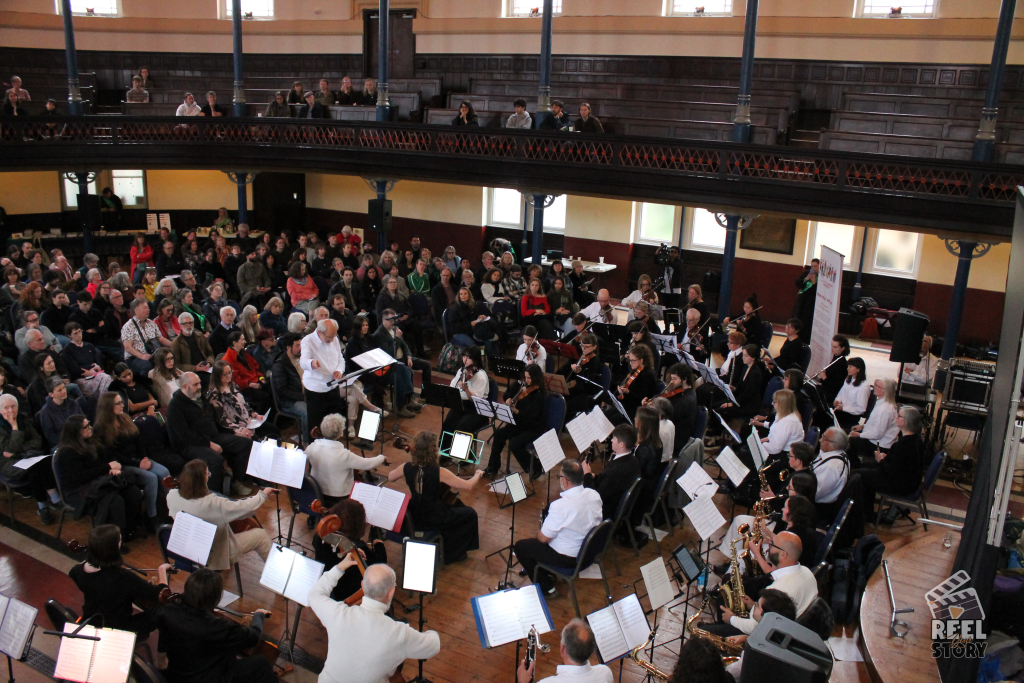
By Katherine Roberts, Secretary of Hackney Community Orchestra.
There are plenty of reasons to love being Hackney’s local community orchestra, but one of the biggest has to be the borough’s extraordinary musical heritage. Music has been woven into the fabric of this part of London for centuries, so when we were invited to take part in Hackney History Festival we didn’t hesitate. The idea? To create a concert celebrating local musicians, paired with a fascinating collection of archive film footage from across the decades.
Simple enough… or so we thought!
Before we ever picked up our instruments, there was a lot of detective work to do. With the help of local archivists, we trawled through old films looking for familiar landmarks and hidden gems, while also diving headfirst into Hackney’s rich musical past.
One of our collaborators was filmmaker David Parker, who introduced us to some remarkable footage shot by Hackney resident Lewis Rosenberg in the 1920s and 30s. Lewis documented everyday life with an incredible eye for detail. In one touching scene, he filmed his wife leaving hospital with their newborn baby. Not all of the footage made the final cut, though. We reluctantly ruled out one particularly lively family holiday film featuring several men dancing naked on the beach! Some things are perhaps best left in the archive…
Lewis’ films also captured moments of enormous historical significance. Among them was footage connected to the Battle of Cable Street, when local residents stood against supporters of fascist leader Oswald Mosley. Discovering these snapshots of Hackney’s past was both moving and inspiring.
Along the way, we were delighted to uncover the stories of two remarkable female composers with Hackney connections. Mary Harvey (1629-1704), who attended school in Lower Clapton, published what are believed to be the first works by a woman in England under her own name. Her teacher, the composer Henry Lawes, praised her music highly, claiming that few composers “of any sex” could rival it. We performed the only three surviving songs attributed to her.
Then there was Mary Ann Pownall (1751-1796), born in Hoxton and baptised in Shoreditch. Apprenticed to an organist as a young girl, she made her stage debut at just fifteen and went on to perform at both Drury Lane and Covent Garden. To bring her music back to life was a genuine privilege.
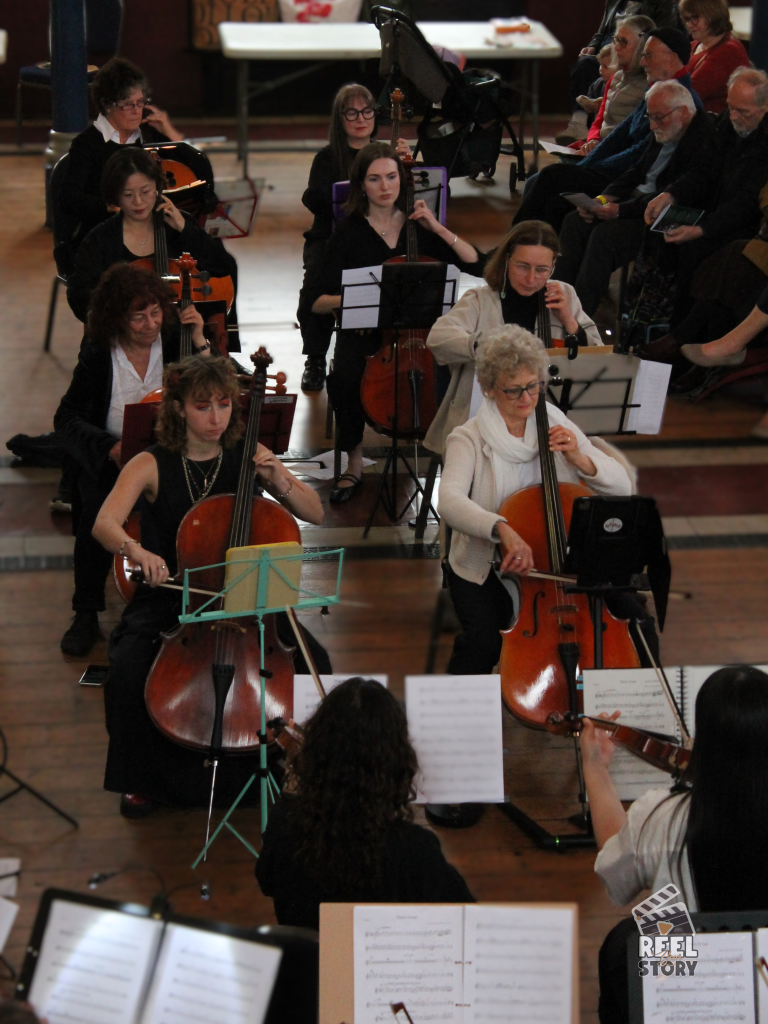
Some musical choices fell neatly into place. Our arrangement of Bei Mir Bist Du Schön worked perfectly with one of the Rosenberg films. We created new arrangements too, including Hackney-born Helen Shapiro’s Walking Back to Happiness to accompany footage of Clissold Park in the 1960s, and a selection of T. Rex classics – a nod to Stoke Newington’s own Marc Bolan – for scenes from the 1970s.
Of course, no musical celebration of Hackney could overlook the contribution of the music hall to Hackney’s musical history. Marie Lloyd, the “Queen of the Music Hall”, was Hackney born and began her singing career in Hoxton while Nelly Power, lived in Hackney and is buried in Abney Park Cemetery. Both artistes sang The Boy in the Gallery, and as no footage was available to accompany our arrangement of the song, David cleverly pieced together a sequence using historic photographs and images from Abney Park.
In a further recognition of the importance of this genre in Hackney’s history, we rounded off our concert with A Night at the Music Hall, a medley of songs which might have been featured in Hackney Empire in its heyday as a music-hall venue.
Throughout the process, our aim was always to make meaningful connections between the music and the films. We eventually narrowed our ideas down to a dozen pieces. Our musical director, Chris Harrison, chose the music, David selected the footage, and then came the nervous part: would they actually work together? Would one overshadow the other? Fortunately, we soon realised they complemented each other beautifully.
We were also aware that what we had created was only a glimpse of Hackney’s history rather than a complete picture. But perhaps that’s part of the joy of projects like this. There are always more stories waiting to be uncovered, more music to rediscover and more films to explore.
The schedule was undeniably tight, but somehow everything came together in time for the performance. We were especially pleased that Laura Clamp, Lewis Rosenberg’s granddaughter, was able to join us and share memories of her grandfather with the audience.
From the very first piece, the audience embraced the project wholeheartedly. Their enthusiasm carried us through the performance and the clapping at the end let us know we’d done a good job! We’ve already been invited back and can’t wait to get started with some new ideas for next year.
So do come along next time. Hackney’s history has plenty more tunes to sing.